
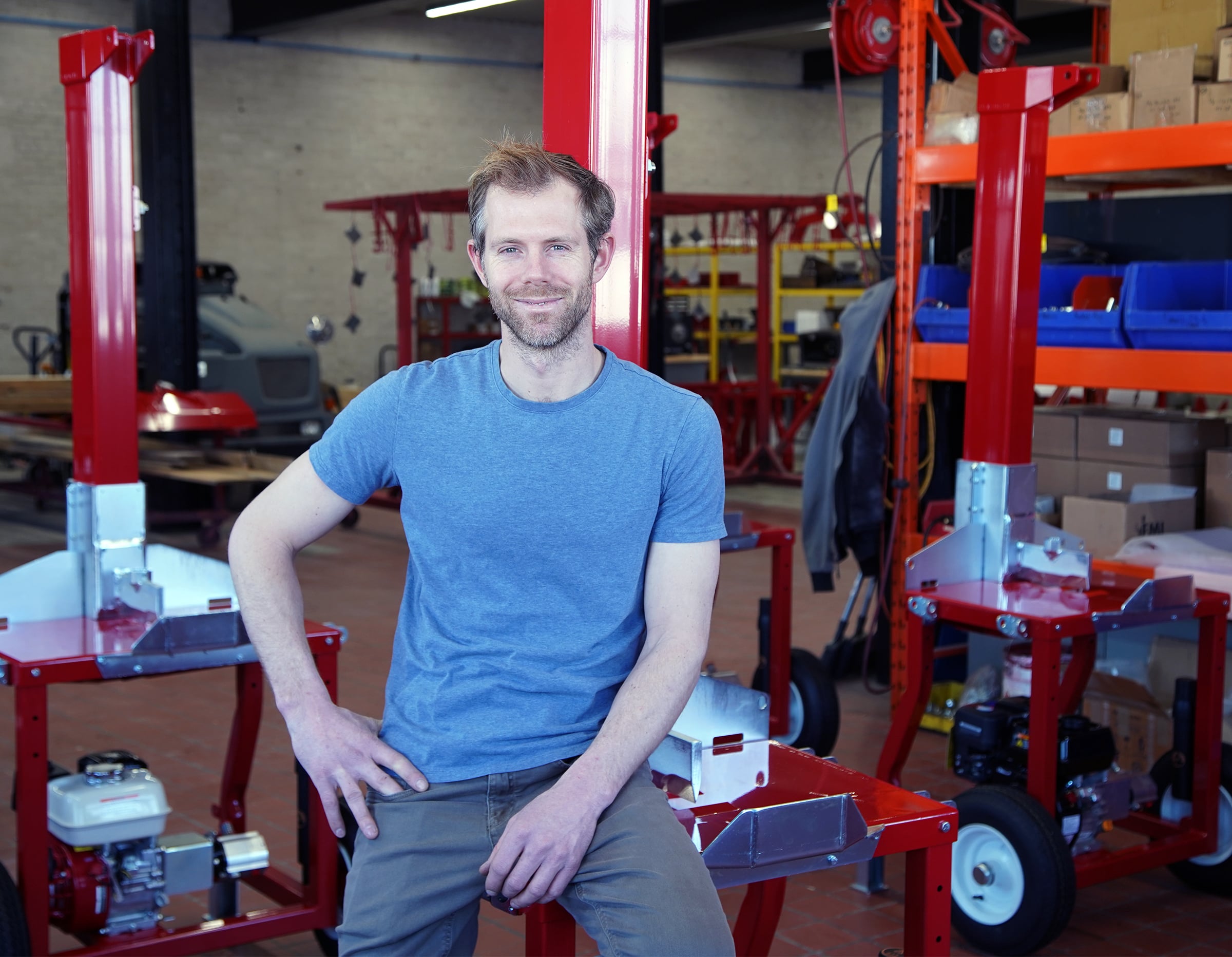
Marco Vanderweerd’s background laid the foundation for Split-Fire’s evolution as a wood splitter and chipper producer.
But it’s the creative force which continues to drive him that will carry the company into the future. “I’m a builder,” said Split-Fire’s youthful CEO, responsible for executive decisions, future growth and product development. “It always makes me happy when I see something in my head, build it, and it solves a problem.”
Vanderweerd’s evolution flows through a combination of genetics and education. His father Bert was also an inventor, experience with general farm equipment repairs leading to the company’s foundation in 1984. Marco and his brothers grew up working in the business, heading into the shop to weld for three hours upon returning home from school. His holistic understanding of the company builds on that base of mechanical knowledge with an economics degree, ‘learning the numbers game’ while at the University of Western Ontario in London.
Vanderweerd would need every bit of both forms of education with the early passing of his father, sitting down with his mother Corina for a pivotal meeting in 2014. “Either I’m going to do this or I’m not going to do this.”
Marco did assume leadership of the company, an admittedly challenging transformation.
“I grew up very quickly,” said Vanderweerd, who with a laugh, added that he ‘feels like 50 some days.’
He has been joined in the ongoing venture by wife Andrea, ‘an incredible and super supportive woman’ originally from Cape Breton. “She is an absolute rock.”
With great appreciation he also highlights that his team’s dedication and support has been critical to the company’s success. “I have quite a few dedicated long-time employees that have worked at Split-Fire for 10, 15, 20 years – they have played key roles with Split-Fire’s growth.”
Split-Fire has grown and matured along with Marco, expanding from its previous 13,000-square-foot facility along Airport Road outside of Norwich, to a beautiful newly-renovated 40,000-square-foot century-plus-old structure at the community’s western edge.
“The second I walked in, I knew exactly what it had to look like,” said Vanderweerd of a bright, open, structure resembling high-end luxury condos as much as a construction plant. Function meets form inside the space, large windows letting in natural light, a powerful filtering system cleaning the air supply every five minutes.
“A clean, happy work environment is very important,” said Vanderweerd, who embraces environmentally-friendly initiatives including recycling and a powder-coating, rather than painting system for their products. “That finish is better for the customers too.”
Wood splitters are Split-Fire’s ‘bread and butter’ says Vanderweerd, with chippers an area identified for expansion. Their traditional customer would be landowners looking to service their own needs, firewood sellers, and equipment rental companies seeking a functional and dependable splitter they can expect to perform for 20 years.
“We fit that market very well.”
Their line of horizontal splitters runs from 400 pounds in weight to 2,500 pounds, able to handle six-inch logs up to huge 48-inch rounds mounted with an excavator. “A massive log split down to boiler wood.”
Split-Fire also produces vertical units, an up-and-coming design geared to precision splitting for pizza oven or meat smokers. “You’re talking smoke wood and cook wood.”
Quality is a company benchmark, along with customer service.
“Split-Fire’s real goal is to produce high-quality innovative equipment that makes people happy,” said Vanderweerd, a definition including products which solve a problem, work efficiently and as advertised, backed up by a positive customer experience.
“When you call Split-Fire you are going to get someone on the phone who knows the machine and will provide you a solution.”
Innovative design leading to functionality and a product ‘which sells itself’ is woven deeply into the company’s DNA, beginning with the ‘two-way split’, one of Marco’s father’s inventions from the 1980s. Marco carries every bit of that creative gene, tempered with the desire to ensure concepts are grounded in practical reality.
“Viability is super, super important.”
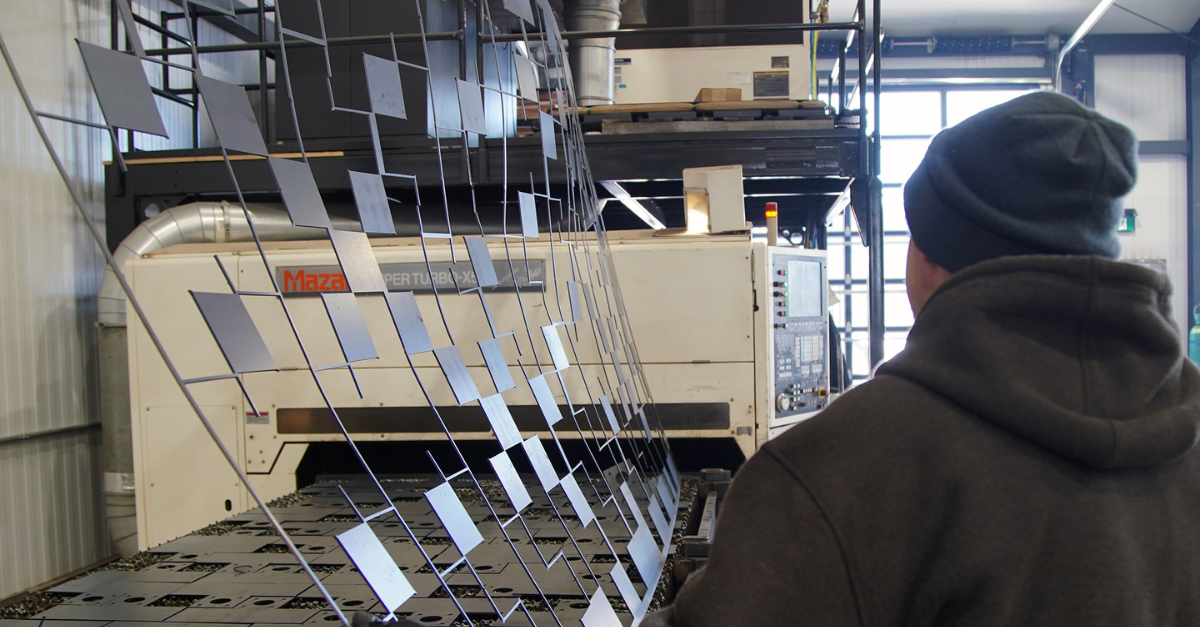
Split-Fire is a ‘living wage plus’ employer of 25, embracing new technologies for repetitive tasks in partnership with its human workforce, not to replace them. Vertical integration is a company principle, trying to source components in-house where possible, which Vanderweerd believes promotes innovation, eliminates supply-chain issues, is quicker and increases employee engagement.
“And it generally produces a better quality product.”
Split-Fire products are sold across North America, 75 per cent of those, to the United States.
“It requires flexibility and a bit of planning,” said Vanderweerd. “You have to be ready to change, if you have to, and find solutions.”
The company also has market segments in Europe and Australia and New Zealand, the latter nation’s dearth of natural resources meaning an ongoing reliance on wood for water heaters, for example.
“Every single farm in New Zealand has a log splitter,” said Vanderweerd.
Renovations for Split-Fire’s three-fold expansion to its current location began in September, 2024, completed in October, 2025. There is room for additional growth on the property, with the potential for a new facility in the future.
“But in this environment, long-term planning is a fickle thing, that’s just the truth of it.”
Vanderweerd is able however, to reflect on the role his Rural Oxford location plays in Split-Fire’s past, present and future. The area offers a great resource of good employees along with an ideal geographical location to serve the North American market.
“Beyond that, it’s also just a great place to live too,” said Vanderweerd, whose extensive international travel has reinforced his appreciation for his home community and country, proud to put ‘Made In Canada’ stickers on Split-Fire equipment. “We live in an extremely safe place in the world of things.”