
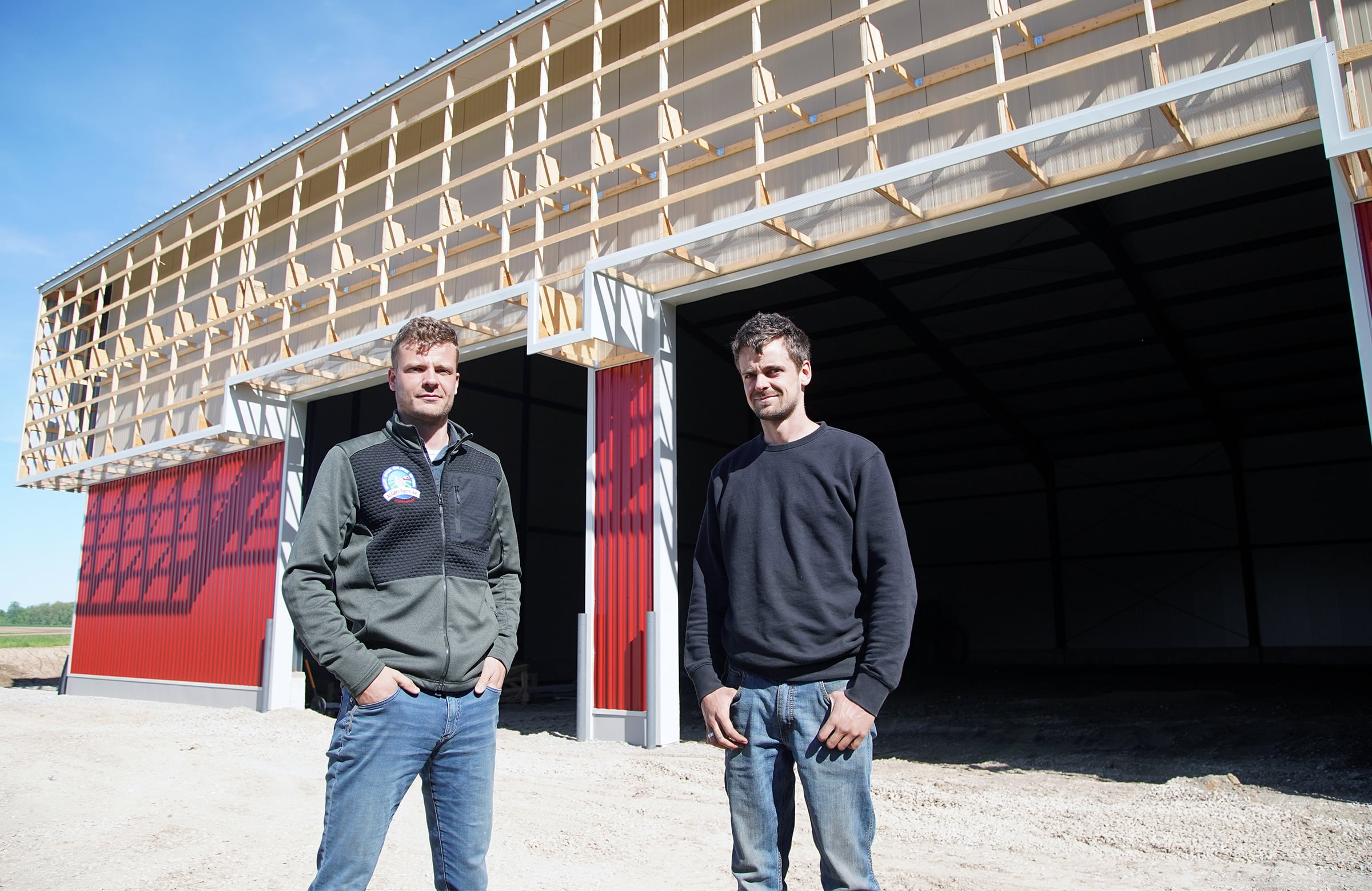
Algro Farms Inc. is embracing mechanical and technological development to build on its tried and true traditional roots, into a long-term sustainable operation growing speciality onions.
“There is no other way to grow,” said operations and sales manager Wilmer Melissant, who along with his brother Joris, in charge of equipment and major projects, are partnering with their father, founder and president Bastiaan ‘Bas’ Melissant.
“It’s about finding that balance between respecting knowledge and experience and the second generation’s way of doing things.”
Bas grew his first onions and garlic at the age of 17, gaining experience as a contractor, buyer, international salesman and grower en route to a position as crop manager with TOP Onions, a global supplier based in The Netherlands. Part of that sales experience came in handy perhaps in convincing wife Marina to emigrate to Canada, a dream first denied with an earlier opportunity in Alberta, subsequently rooted a decade later during a 2010 vacation to Ontario. The Norwich area specifically offered a combination of fertile and visually appealing farmland, access to quality labour and proximity to a community including established Dutch culture.
“I guess that’s where she fell in love and so did we,” said Wilmer, who was 16 at the time, Joris 14.
Bas purchased the company’s home 264813 Maple Dell Road property in 2011, putting the first crop of specialty onions in the ground in the spring of 2012 via farm manager Herman Visscher.
With slow, sequential expansion of between 10 and 15 per cent annually, Algro currently farms 400 acres, the majority of which shallots, and the balance divided between cipollini, white, red and gold pearls, and red onions.
Planting via seed begins in mid April with white pearls maturing on August 15th, the bulk of other varieties ideally harvested through September, weather permitting. Onions go into cold storage and are graded, packed and shipped to wholesalers year-round. Over two thirds of Algro’s production goes to the United States. Oxford County is not a traditional specialty onion-producing area, however does provide geographical shipping advantages to population centres in New York, Pennsylvania and the eastern seaboard.
Transition is currently tariff-free as a specialty agricultural product. Should that change, Algro is prepared to pivot production to domestic demand.
The company’s growth can be measured in many ways beyond the simple math of 30 to 400 acres. First, there is progression from the original barn converted into a multi-purpose storage, grading, packing and shipping facility, through what now are nine structures, the latest a 250-by-125-foot cold and covered storage unit which when completed, will complete production ‘flow’ says Wilmer. It can also be seen in broad-based mechanical and technical development. Grading and packing lines have massively more capacity than the originals, where employees hand-sealed each bag as it came off the line.
“One bag a time,” Wilmer smiled.
He and Joris are also equally proud of an AI-based weed-control sprayer. Featuring cameras, software and three 88-inch rows of tightly packed nozzles, spraying individual weeds in a precise, targeted approach rather than the blanket application of previous models accomplished a 97 per cent savings in herbicides throughout 2025!! This technology offers significant benefit to the specialty crop and overall consumer health, which makes the family honoured to have been selected as one of Bioenterprise Canada’s Round 2 Sustainable Growth and Adoption Program Recipients. Learn about the program here.
Finally, there is an effort to create confluence between the ‘art’ of years of experience around growing an admittedly finicky speciality crop contained within the heads of Bas and Visscher, who remains an integral part of the business with regards to fertigation, spraying and irrigation, into the ‘science’ of documentation and SOPs. Bas can walk into a field says Wilmer, and instinctively know what must be done, down to the tiniest detail.
From spring to fall, there is a requirement to be ‘early to the field’, keeping a close eye on a crop where both opportunity and problems can develop in a hurry.
“I want all of this written down somewhere,” Wilmer explained. “We need to extract and document that knowledge and have it in place.”
His winters are spent crunching numbers, on sales and attending trade shows. Maintaining personal connections is also very much a core company value. Specialty onions are a highly-competitive marketplace, but Algro is a testament to Bas’ ability to maintain long-term relationships and the focus the family puts on the same. Wilmer regularly visits customers, is always available via phone and if an issue arises, will travel to the USA to deal with it ‘face to face.’
As the saying goes, if it was easy, everyone would be doing it. Specialty onions are viewed as a high-risk crop with unique field and sector challenges.
“There is always pressure, but we love it that way. I think that’s what makes it unique.”
He views the approach as 50 per cent farm and 50 per cent business – or 100 per cent to both – vitally important to be in control of ‘the numbers’ to keep things manageable.
“We exist, but we’re on our toes all the time,” Wilmer concluded. “We have to make a lot of smart decisions to keep things growing, I’ll say that.”
Learn more about Algro Farms:
https://algrofarms.com